Start growing
Needs support (trellis) and regular pruning. Thrives in full sun and well-drained soil.
GROW SOMETHING WONDERFUL
Rubus fruticosus
Your guide to planting, growing, and getting to know this plant.
THE PLANT NOTEBOOK
Needs support (trellis) and regular pruning. Thrives in full sun and well-drained soil.
Watch the 'arch' of the blackberry cane in your Seeds In A Cup® observation kit—a classic vining behavior.
By tip layering, cuttings, or seeds.
Canes grow the first year and produce fruit the second year (except primocane-fruiting varieties).
Hedgerows, woodland edges, and disturbed areas.
Heat tolerant; sensitive to extreme winter freezes in some cultivars.
Spotted wing drosophila and cane borers.
Safe; watch for thorns in wild varieties.
A sprawling perennial shrub with biennial thorny canes. Produces aggregate fruits (drupelets).
‘Triple Crown’ (Thornless), ‘Prime-Ark Freedom’.
Eating fresh, pies, jams, and traditional wine
Native to Europe and Asia; widely naturalized in North America.
Secure; often considered a weed in optimal growing conditions.
From the Latin ‘ruber’ (red), though the mature fruit is deep black.
Leaves were used by ancient Greeks to treat gout and by the British to make traditional 'Bramble Jelly'.
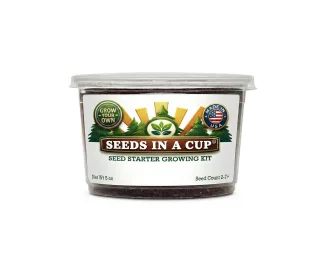
Tree Seed Starter Kit
USD 14.99
Currently unavailable
Rubus fruticosus